
Renovating without an independent inspection means hiring the contractor to police themselves.
34% of renovations in Portugal exceed the initial budget, almost always due to problems that existed before works started and that an independent inspection would have identified.
See what the pre-renovation survey includes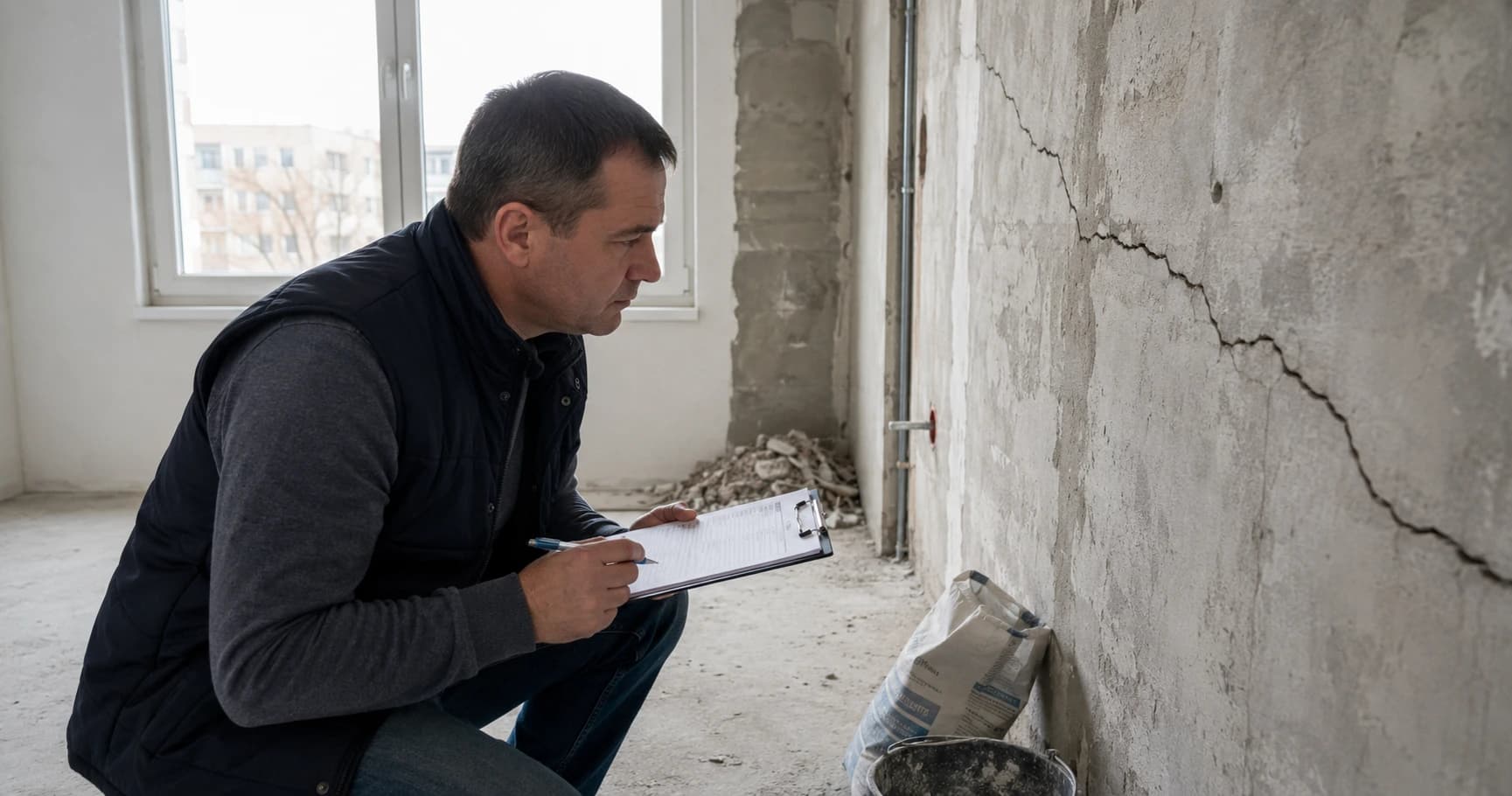
EU mandatory deadline
EPBD: rules for existing homes are still being defined
Portugal has not yet defined how the EPBD will apply to existing homes. Planning now with the Renovation Passport orders the works by return and prepares the documentation grant programmes commonly ask for.
Grant available
PRR: up to 65% of eligible rehabilitation cost
Requires energy certificate and technical report signed by an OE engineer. The Renovation Passport prepares both.
Inspection services
Inspections for every stage of your renovation
Coverage at each stage of the process: pre-works, during works and at handover. Each inspection has a specific purpose and the right moment.
Pre-Works Survey
Phase 1: Start here
Full condition assessment before any works. Identifies hidden damp, structural issues, failing installations and asbestos risk in pre-1985 properties. Report in 48h. Documentary baseline for negotiating the contractor agreement.
Learn moreRenovation Passport
Plan + documentation
Goes beyond the survey: energy audit, BIM modelling, ROI-sequenced intervention roadmap, and the technical documentation that grant and green-loan programmes commonly ask for. It combines diagnosis and plan in one service.
Learn moreStructural & Seismic Inspection
With structures open
Assessment of beams, columns, slabs and foundations when exposed. The only moment to inspect what is normally hidden. In 1960s-80s buildings, concrete carbonation and rebar corrosion are frequent findings that completely change the budget.
Learn moreMoisture Inspection
Calibrated hygrometer
Detection with pin and non-contact hygrometers, plus visual moisture survey. In Portuguese renovations, non-visible moisture in existing walls is the number one cause of work stoppage and rework. Found before works start, treatment cost is a fraction of what it would be mid-renovation.
Learn moreEnergy Certificate
Mandatory for major works
Mandatory after major renovation works under the SCE (DL 101-D/2020), and for any sale or rental. Lenders and grant programmes commonly ask for it; conditions vary. Produced by an ADENE-qualified expert.
Learn moreThe Pre-Works Survey and the Renovation Passport are complementary services. The Survey assesses current condition; the Passport plans interventions by return and prepares the documentation for applications. For comprehensive renovations, we recommend starting with the Passport.
Independent oversight
Why the contractor cannot replace the inspector
The contractor is not your adversary, but their incentives are different from yours. Here's why.
Conflict of interest
The contractor bills more when problems emerge. Each mid-renovation surprise is an opportunity to charge extras. Without a prior independent inspection, there is no documented baseline to dispute additional costs.
Fragmented expertise
Most contractors specialise in one area: civil, electrical or plumbing. A renovation inspection covers all simultaneously: structure, moisture, energy, acoustics and installations, distinct domains requiring distinct expertise.
No documentary accountability
Without an independent technical report signed by an OE-registered engineer, there is no proof of the property's initial condition. In contractor disputes, the absence of pre-works documentation is almost always fatal for the owner.
Uncontrolled scope creep
Without documented initial diagnosis, any problem found mid-works seems inevitable and the budget grows without visible limit. With the pre-works survey, you know exactly what was there before, and what the contractor should have included in the original quote.
Portuguese housing stock
Your property has a history. The inspection reads it.
72% of residential properties in Portugal were built before 1990. Each construction era has specific pathologies (some invisible, some dangerous) that only a specialist inspection can identify before works begin.
Before 1960
Traditional masonry
- Lead or galvanised iron pipes
- Possible asbestos in renders, roof tiles and pipes
- Timber structure with xylophage attack
- Non-updated Bergmann tube electrical installation
1960 – 1985
First-generation reinforced concrete
- Carbonation and corrosion of steel rebars
- Drainage in fibrecement (contains asbestos)
- Steel window frames without thermal break
- No insulation or degraded mineral wool
1985 – 2000
Pre-energy-regulation construction
- Poorly applied ETICS with hidden joint infiltration
- Aluminium frames without thermal break (cold bridges)
- Concrete slabs with cracks and delamination signs
- Undersized electrical installations (< 40A)
Data: INE Census 2021. Precise identification of era-specific pathologies requires an on-site inspection: construction era is a risk indicator, not a diagnosis.
Inspection process
The 4 phases of renovation inspection
Each renovation phase has a right moment to inspect and a different set of risks. Skipping any phase increases the probability of unforeseen costs.
Before hiring the contractor
Pre-Works Survey and/or Renovation Passport. Full diagnosis, hidden risk mapping, realistic budget before signing any contract. The most important phase, and the most overlooked.
With structures exposed
When walls or floors are open and before new installations. The only moment to inspect what is normally hidden: beams, columns, foundations, buried pipes.
Before closing the walls
Before plastering or installing drywall: verification of electrical, plumbing, HVAC and insulation. Problems here cost far less than after everything is closed and finished.
At handover
Final snagging and the certifications the works require: energy certificate, acoustic certification, electrical compliance. Lenders and grant programmes commonly ask for them.
Mid-works surprises
What contractors discover mid-works
These are the most common problems that emerge in Portuguese renovations after works have started. All could have been identified in a pre-works inspection.
Hidden damp discovered mid-renovation
Removal of already-applied finishes + treatment + reapplication
Unforeseen structural problems
Structural engineer + slab or foundation reinforcement + work stoppage
Full electrical installation replacement
Open works throughout + complete new cabling + new board
Asbestos in demolition materials
Specialist removal + site decontamination + mandatory environmental report
Grants and incentives
Available financing for renovations in Portugal
Most owners don't know that a technical inspection is a prerequisite for accessing these programmes, and that the Renovation Passport prepares all the required documentation.
PRR: Reabilitação Urbana
Recovery and Resilience Plan
Green Mortgage
Preferential conditions after energy upgrade
IFRRU 2020–2030
Financial Instrument for Urban Rehabilitation
ARU: Tax Incentives
Urban Rehabilitation Areas (Portuguese municipalities)
What renovators need to know
- Before hiring the contractor and before finalising the budget. The survey reveals hidden problems (damp, degraded installations, structural risks) that change the scope and cost of works. Done after the contractor starts, it loses its negotiation value and the documentary baseline that protects the owner in the event of a dispute.
- The Pre-Works Survey assesses the current condition of the property: what is degraded, what represents risks, what needs immediate repair. It's the starting point. The Renovation Passport goes further: energy audit, BIM modelling, ROI-sequenced intervention roadmap, and the technical documentation that grant and green-loan programmes commonly ask for. For comprehensive renovations the Passport is the complete plan.
- It can. The Renovation Passport prepares the technical documentation that grant programmes and lenders commonly ask for, and identifies the most efficient interventions to raise the energy class. Each programme and each lender sets its own conditions, so check them before you apply.
- Properties built before 1985 are at high risk. Asbestos may be present in spray renders, fibrecement roof tiles, drain pipes, pipe joints and ceiling panels. The Pre-Works Survey includes asbestos risk assessment and laboratory testing recommendations when necessary. Removal without a certified procedure is illegal in Portugal and represents a serious health risk for workers and occupants.
- It depends on the scope. The RRAE (DL 96/2008) requires acoustic certification for rehabilitation works including alterations to walls, ceilings, floors or systems affecting sound insulation between units. Simple finishing works (painting, floating floors, tiles) are normally not covered. The fine for non-compliance can reach €44,891 for individuals.
- An ARU (Urban Rehabilitation Area) is a zone delimited by the municipality where rehabilitation of properties over 30 years benefits from 6% VAT on works (instead of 23%), IMI exemption for up to 3 years, and IRS deduction up to €500/year. IFRRU offers credit at preferential rates (1.5%–2%) for ARU properties. Most historic centres and riverside areas of Portuguese cities are ARUs.
- InspectOS reports are produced by engineers registered with the Ordem dos Engenheiros de Portugal and have legal validity. A contractor may disagree with the findings but cannot invalidate a technical report signed by a qualified expert. In disputes, the report is accepted as evidence in mediation, arbitration and court proceedings. The existence of a pre-works report is frequently decisive in the outcome of construction disputes in Portugal.
Most renovation cost overruns trace back to problems that were there before work started.
Every week you wait is a week closer to starting without a technical foundation. And without a technical foundation, the budget is just an estimate.