
Damp walls, salt and condensation: InspectOS Pro section B
Section B of InspectOS Pro records signs of damp, the state of the insulation and the home's ventilation. It is a visual check within the general inspection. An active damp problem calls for the dedicated moisture inspection, which uses its own module.
InspectOS Pro is rolling out in phases. Some capabilities described below are still being built.
Damp walls, salt deposits and condensation
Damp walls: rising damp or water getting in?
Damp at the base of a wall, with a tide mark and flaking paint, is the typical sign of rising damp. Damp higher up, under windows or near the roof, more often points to rainwater getting in. The engineer rates the presence of moisture from minor stains to rising damp, active infiltration or mould.
Checkpoints in the method: B1.1
Salt deposits on walls
White, powdery deposits on a wall are salts left behind as water evaporates. They show that water has moved through the wall, even when the surface feels dry on the day of the visit. The engineer notes them with the moisture rating.
Checkpoints in the method: B1.1
Condensation on windows
Water on the inside of the glass on cold mornings is condensation. On windows, it points to ventilation and insulation. When it spreads across walls, mould tends to follow. The method separates condensation on windows from widespread condensation and records the ventilation of every room.
Rainwater getting into walls
Rainwater enters through the roof, terraces, facade or window frames, and often appears far from where it got in. The engineer checks that roofs and terraces are watertight and that window frames are sealed.
Checkpoints in the method: B1.3
The inspection is visual: the engineer works through each checkpoint on site and records the condition found on the day.
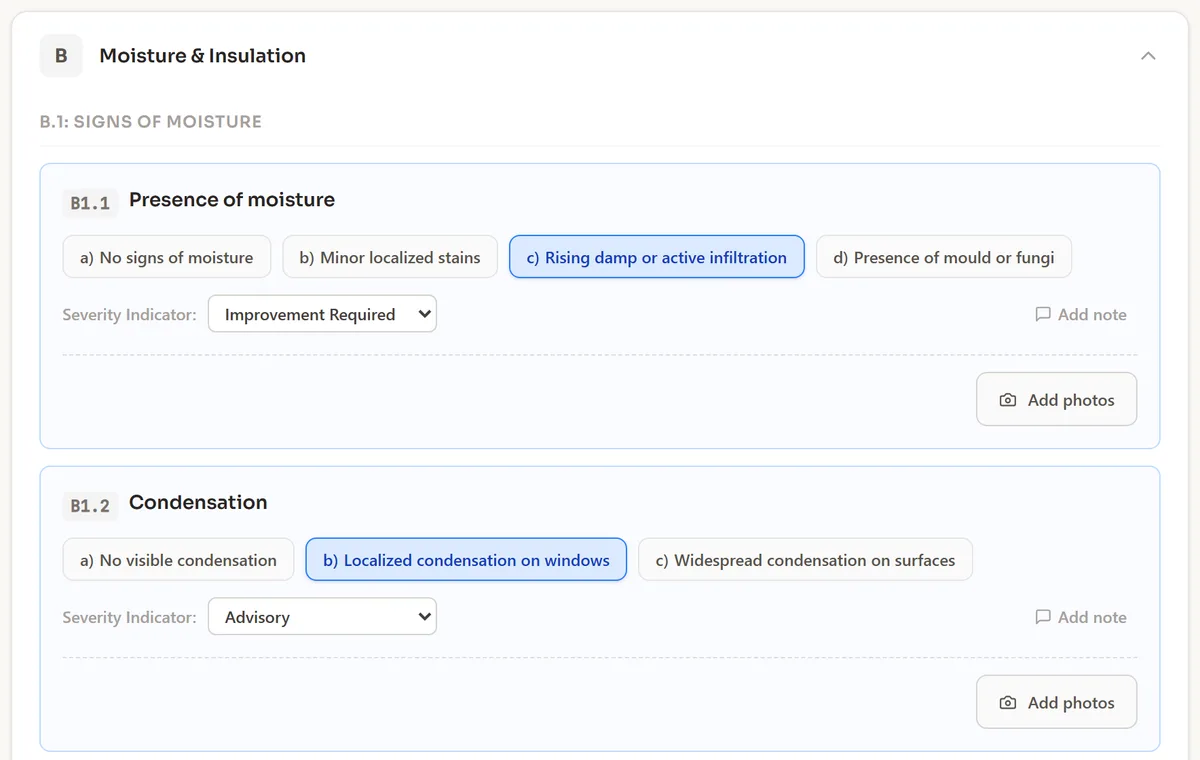
B.1: Signs of Moisture
- B1.1Presence of moistureCritical checkpoint
Possible answers
- a)No signs of moisture
- b)Minor localized stains
- c)Rising damp or active infiltration
- d)Presence of mould or fungi
- B1.2Condensation
Possible answers
- a)No visible condensation
- b)Localized condensation on windows
- c)Widespread condensation on surfaces
- B1.3Waterproofing
Possible answers
- a)Roofs and terraces watertight
- b)Signs of waterproofing degradation
- c)Active roof infiltration
B.2: Thermal Insulation
- B2.1Wall thermal insulationCritical checkpoint
Possible answers
- a)Adequate insulation per regulations
- b)Insufficient or partial insulation
- c)No detectable insulation
- B2.2Roof insulation
Possible answers
- a)Adequate insulation
- b)Partial or degraded insulation
- c)No roof insulation
- B2.3Thermal bridges
Possible answers
- a)No evident thermal bridges
- b)Localized thermal bridges (columns, beams)
- c)Widespread thermal bridges
B.3: Ventilation
- B3.1Natural ventilation
Possible answers
- a)Adequate ventilation in all rooms
- b)Insufficient ventilation in some rooms
- c)No adequate natural ventilation
- B3.2Mechanical ventilation
Possible answers
- a)System functional and in good condition
- b)System partially functional
- c)System inoperable or non-existent
What our engineers found
- 53% of 2026 pre-purchase inspections flagged the presence of moisture, the checklist item flagged most often.
What this means for you: Visit after rain if you can, and ask the seller when walls and ceilings were last painted.
From the InspectOS 2026 inspection data, a random sample of our inspections.See the 2026 inspection data
Guides to read next
Frequently asked questions
- Why do salt marks appear on walls?
- Salt marks are salts that water carries out of the wall. When the water evaporates, the salts stay on the surface as white patches. They are a sign of damp, often rising damp, and checkpoint B1.1 records them.
- Are condensation and damp walls the same thing?
- No. Condensation comes from damp indoor air cooling on a cold surface, such as glass and corners. Damp in walls comes from water getting in through the structure. The method keeps them apart: B1.2 records condensation and B1.1 records damp.
- When is a dedicated moisture inspection needed?
- When section B finds rising damp, active water ingress or mould. The moisture inspection follows the water to its likely source, with readings, in its own thirteen-step module.
Book the visit
- Pre-Purchase Inspection
from 595 €
Book - Moisture Inspection
from 750 €
Book