
Seismic vulnerability assessment of a building: InspectOS Pro module
The InspectOS Pro structural and seismic module records a building's seismic vulnerability in nine sections. It uses Eurocode 8 as its reference. A civil engineer registered with the Ordem dos Engenheiros fills it in.
InspectOS Pro is rolling out in phases. Some capabilities described below are still being built.
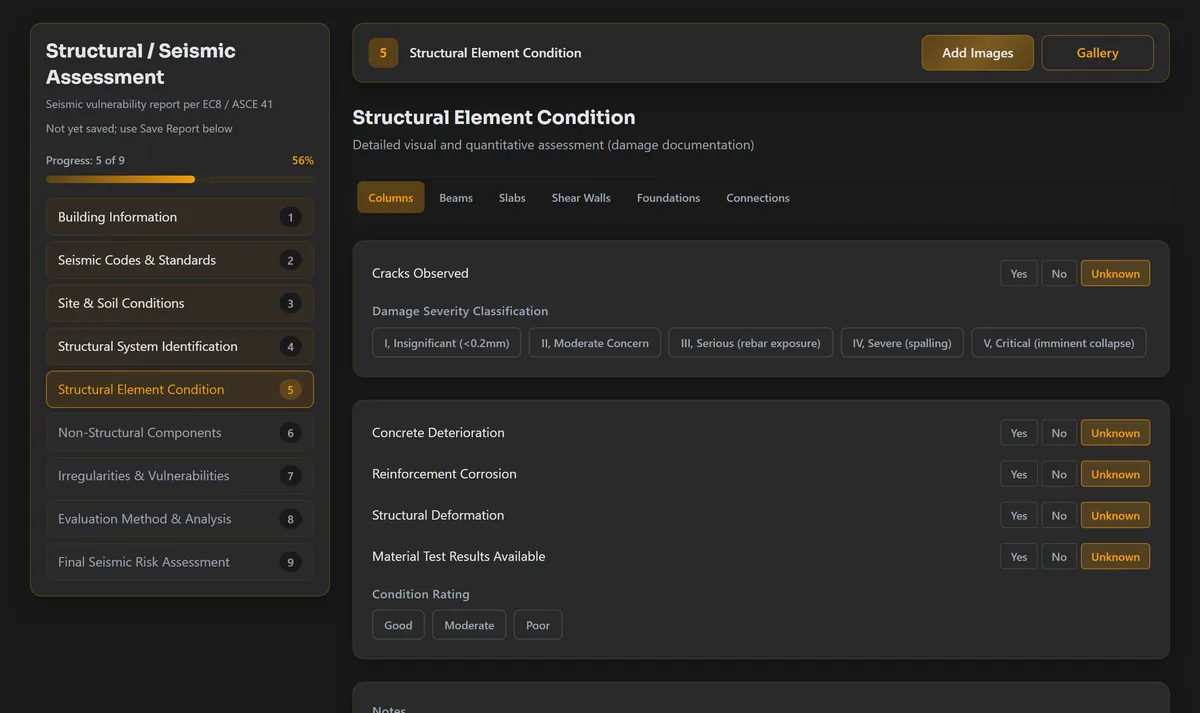
What the module records, and what it means
The building and the rules it was built to
The module records the construction year, the design code year and the importance class. A building older than current seismic rules was designed for other demands.
Fields in the module: Building Type · Sub-type · Year of Construction · Year of Last Major Renovation · Floors Above Ground · Floors Below Ground · Total Building Height (m) · Structural System Type · Original Design Code Year · Importance Class (EC8 I–IV) · Historic / Listed Building · Applicable Seismic Code · Version / Year · Seismic Zone Classification · Design Ground Acceleration (ag or PGA in g) · Soil Category (EC8) · Knowledge Level (KL) · Confidence Factor (CF) · Target Performance Level · Reference Return Periods · Behavior Factor q
The ground
Soil type changes how an earthquake reaches the building. The module records the soil category, the slope, liquefaction risk and how close neighbouring buildings are.
Fields in the module: Soil Type · Soil Classification (EC8 A–E) · Site Slope Conditions · Evidence of Soil Instability · Liquefaction Risk · Nearby Faults / Seismic Hazards · Geotechnical Report Available · Geohazards Checklist · Liquefaction · Landslide · Surface Rupture · Adjacency / Pounding Risk with Neighbouring Buildings
The structure and its weak points
A soft storey, such as an open ground-floor shop, or an irregular plan concentrates forces in an earthquake. The module records each irregularity separately.
Fields in the module: Confirmed Structural System Type · Load-Bearing Elements · Structural Layout Regularity · Load Path Complete? · Structural Symmetry · Redundancy · Soft-Story Presence · Vertical Irregularities · Irregularity Type · Horizontal Irregularities · FEMA Building Type · Diaphragm Type · Weak Storey · Torsional Irregularity · Vertical Irregularity · Plan Irregularity · Short Column Effect · Soft Storey
The condition of the elements
Cracks with measured width, length and orientation, deteriorated concrete and corroded reinforcement. A crack measured on the day of the visit is a baseline for later comparison.
Fields in the module: Cracks Observed · Crack Width (mm) · Length (mm) · Orientation · Damage Severity Classification · Concrete Deterioration · Reinforcement Corrosion · Structural Deformation · Material Test Results Available · Condition Rating
What can fall
Chimneys, parapets and other poorly anchored elements can fall in an earthquake, even when the structure holds. The module records the hazard and the anchoring condition.
Fields in the module: Falling Hazard Risk · Hazard Severity · Anchoring Condition · Damage Severity Classification · Recommend Detailed Evaluation
The conclusion
The module closes with the evaluation method, the seismic safety rating, the expected performance and the recommended actions. Take the recommendations to a designer before deciding on works.
Fields in the module: Evaluation Method Used · Analysis Type · Performance Verification Summary · Seismic Safety Rating · Compliance with Seismic Code · Expected Performance During Earthquake · Risk Classification · Recommended Actions
What the engineer records, section by section
Every field below is in the module, as the engineer fills it in on site.
01Project & Building Information
- Building Type
- Sub-type
- Year of Construction
- Year of Last Major Renovation
- Floors Above Ground
- Floors Below Ground
- Total Building Height (m)
- Structural System Type
- Original Design Code Year
- Importance Class (EC8 I–IV)
- Historic / Listed Building
02Applicable Seismic Codes & Standards
- Applicable Seismic Code
- Version / Year
- Seismic Zone Classification
- Design Ground Acceleration (ag or PGA in g)
- Soil Category (EC8)
- Importance Class (EC8 I–IV)
- Knowledge Level (KL)
- Confidence Factor (CF)
- Target Performance Level
- Reference Return Periods
- Behavior Factor q
03Site & Soil Conditions
- Soil Type
- Soil Classification (EC8 A–E)
- Site Slope Conditions
- Evidence of Soil Instability
- Liquefaction Risk
- Nearby Faults / Seismic Hazards
- Geotechnical Report Available
- Geohazards Checklist
- Liquefaction
- Landslide
- Surface Rupture
- Adjacency / Pounding Risk with Neighbouring Buildings
04Structural System Identification
- Confirmed Structural System Type
- Load-Bearing Elements
- Structural Layout Regularity
- Load Path Complete?
- Structural Symmetry
- Redundancy
- Soft-Story Presence
- Vertical Irregularities
- Irregularity Type
- Horizontal Irregularities
- FEMA Building Type
- Diaphragm Type
05Structural Element Condition
- Cracks Observed
- Crack Width (mm)
- Length (mm)
- Orientation
- Damage Severity Classification
- Concrete Deterioration
- Reinforcement Corrosion
- Structural Deformation
- Material Test Results Available
- Condition Rating
06Non-Structural Components Risk
- Falling Hazard Risk
- Hazard Severity
- Anchoring Condition
- Damage Severity Classification
- Recommend Detailed Evaluation
07Structural Irregularities & Vulnerabilities
- Weak Storey
- Torsional Irregularity
- Vertical Irregularity
- Plan Irregularity
- Short Column Effect
- Soft Storey
08Seismic Evaluation Method & Analysis
- Evaluation Method Used
- Analysis Type
- Performance Verification Summary
09Final Seismic Risk Assessment & Recommendations
- Seismic Safety Rating
- Compliance with Seismic Code
- Expected Performance During Earthquake
- Risk Classification
- Recommended Actions
Who fills it in
Civil engineer registered with the Ordem dos Engenheiros (OE)
What the law says
- Under Portaria n.º 302/2019, extension, alteration or reconstruction works need a seismic vulnerability assessment report when the structure shows clear signs of degradation, when the works change the building's structural behaviour, or when the area worked on or the cost of the works exceeds 25% of the building or of an equivalent new building. (Portaria 302/2019, art. 1.º n.º 1)
- If the report finds that the building does not meet 90% of the seismic action defined in NP EN 1998-3:2017, a seismic reinforcement project becomes mandatory. (Portaria 302/2019, art. 1.º n.º 3)
Guides to read next
Frequently asked questions
- When is a seismic vulnerability assessment required?
- In extension, alteration or reconstruction works, when the structure shows clear degradation, when the works change its structural behaviour, or when the area or cost of the works exceeds 25% of the building (Portaria n.º 302/2019, art. 1(1)).
- What happens if the building fails the assessment?
- If the report finds the building does not meet 90% of the seismic action in NP EN 1998-3:2017, a seismic reinforcement project becomes mandatory (Portaria n.º 302/2019, art. 1(3)).
- Who carries out the seismic assessment?
- A civil engineer registered with the Ordem dos Engenheiros. The module uses Eurocode 8 as its reference and records the soil, the structural system, irregularities and the final risk assessment.
Book the visit
- Structural & Seismic
from 2,250 €
Book